Search by Recipe or Ingredient

11.13.2010

Act 1: Kenshin - Himura Battosai: A Few Quick Words About Shopping for Japanese Ingredients with Your Chinese Friend

"140 years ago in Kyoto, with the coming of the 'Black Ships' there arose a warrior called Hitokiri Battosai.  Felling men with his blood stained blade, he closed the turbulent Bakumatsu Era and slashed open the age known as Meiji.  Then he vanished, and with the flow of years, became a legend.  This tale begins in the 11th year of Meiji, in the middle of Tokyo."

Book:  Rurouni Kenshin by Nobuhiro Watsuki
Recipes:  The Complete Book of Japanese Cooking by Emi Kazuko

When I announced that I wanted to cook Japanese, I asked my friend Yan to take me shopping in Chinatown.  She speaks Chinese and knows all the best shopping markets there.  We work together and over the years we have come to enjoy taking trips downtown after work for some delicious meals in restaurants that Yan seeks out.  We haven't been able to get together for those meals as much lately, so it was a nice way for us to resurrect our habit and get me the ingredients I wanted all at the same time.

We picked a date, I made a list, and we headed out.  My list had things like umeboshi, and daikon, and shoyu, and mirin on it.  I just copied them out of the cookbook the way I would have copied out a shopping list for eggs, and flour, and milk.  I guess I was  trusting that it would be obvious.

Of course it wasn't because the Chinese names for these foods are in Chinese and the Japanese names aren't always written out in Western characters, and of course, neither Yan nor I can read Japanese.  We were at a complete loss for many of them.    We were straining our eyes, searching the Japanese aisle for Shoyu, when Yan made the discovery that it's simply soy sauce. I felt extremely foolish and didn't want to waste any more of Yan's time. We shortened the list to what we could discover easily, and we went on our way. 

Words of advice:   All of the cookbooks I bought have entire chapters dedicated to the different ingredients and what they look like.  I have since discovered that it's wise to read them before going to the store.

Yan was very patient and helpful throughout the whole process and I made sure to thank her with a tupperware full of my first dish.  We took some pictures of us in the store, but I lost my phone before we could upload them.

You'll just have to take my word for it, it was a lot of fun.

11.07.2010

Story 2: Linguade e Pimentoes com Molho De Coco e Gengibre, and If Only I Spoke Javanese

"I had just recently arrived in Rio (I continued) and was living in literal poverty.  I was spending most of my time away from the boarding house, not knowing where or how to earn some money, when I saw the following advertisement in the Journal of Commerce:  'Wanted:  A teacher of Javanese.  References, etc.'  Now I said to myself, there's a job without many competitors; If I knew half a dozen words, I'd offer myself."

Book:  Oxford Anthology of the Brazilian Short Story
Recipes:  The Brazilian Kitchen by Leticia Moreinos Shwartz

Linguade e Pimentoes com Molho De Coco e Gengibre
Sole with Coconut Ginger Sauce

For the peppers:   

2 tbsp olive oil
1/2 cup each chopped red, yellow, and green bell pepper
1/2 cup finely chopped shallots
2 cloves garlic, pressed
1 tbsp fresh chopped thyme


For the sauce: 

1 tbsp olive oil
1/3 cup of finely chopped shallots
2 cloves garlic, pressed
1/4 cup fresh shredded ginger
1/4 cup dry white wine
1 cup coconut milk
1 1/2 cups fish stock
Salt and pepper to taste 

For the sole:

4 fillets of sole, skinless, about 6 oz each
1 cup flour
2 tbsp butter


Heat 2 tbsp of oil in a saute pan over medium heat.  Add peppers and 1/2 cup of shallots and saute until soft, about 3 minutes.  Add the garlic and cook another minute.  Remove from heat and add salt, pepper, and thyme; keep warm.  


Heat the remaining olive oil and shallots in a pan over medium heat until translucent, about 5 minutes.  Add the ginger and garlic and continue stirring for another 2 minutes.  Pour in the white wine and reduce by 80%.  Add the fish stock and bring to a boil.  Add the coconut milk and stir well, cook over low heat until the sauce thickens enough to coat the back of a spoon.  Pass the sauce through a mesh sieve and discard the solids.  Salt and pepper to taste and keep warm. 


Pat the fillets of sole dry with a paper towel, season with salt and pepper on both sides, then dredge the fillets in the flour.  Heat butter over medium heat and swirl to cover the whole pan.  Gently lay the fish in the skillet and avoid moving them so that a golden crust forms.  Cook until the fillets are golden brown, about 2 minutes on each side.  


Spread a thin layer of the warm peppers over each fillet, then spoon sauce onto the plate around the fillets.  


We served ours with steamed broccoli and roasted potatoes with garlic.  It was delicious.  To use up the pepper mixture, I added more than a "thin" layer, which was fine by me, but I noticed that Jay scraped a hefty amount of his off to the side. It did overwhelm the dish a bit, I must admit.  The sauce was wonderful. 


About the book and the blogging:

This story sort of tickled my fancy because it's about a pseudo-teacher who learns a few things in Javanese and passes himself off as a language instructor to his wealthy benefactor.  He and his student work their way through an old family heirloom book and I honestly can't even remember what the book was about.  He does such a good job faking his Javanese skills, that he becomes a sort of councilman and I don't remember how that ends either.  The truth is, these short stories didn't really grab my full attention.  Which leads me into my next paragraph about why it's been so long since I've cooked or written anything.

After I got back from my vacation this summer, I think I was just a little tired of cooking.  And I didn't want to read any more Brazilian stories.  Short stories are great, when you want a quick fix, but I found myself caught up in a Young Adult series recommended by a student (Cirque du Freak - It was pretty good.).  I didn't have a lot of motivation to even begin to write about this last recipe, even though it was such a good one.  It nagged at  me though, and a few weeks ago, I decided that maybe it was just time to give up on the Brazilian literature and move on.  My next adventure will be in Japanese food, and I've already got a handful of recipes waiting to be written about.  I also have an extra special treat for my first book, a Manga that was loaned to me by a student.  


Look for a new line-up in the days the come, and thanks for staying loyal even when I wasn't keep up with my side of things. 

8.23.2010

Story 1: Enrolado do Bife com Frango, Torta Capixaba, and Sometimes Fortune Tellers Lie

"Hamlet observes to Horatio that there are more things in heaven and earth than are dreamt of in our philosophy. This was the selfsame explanation that was given by beautiful Rita to her lover, Camillo, on a certain Friday of November, 1869, when Camillo laughed at her for having gone, the previous evening, to consult a fortune-teller. The only difference is that she made her explanation in other words."

 Book:  Oxford Anthology of the Brazilian Short Story
Recipes:  The Brazilian Kitchen by Leticia Moreinos Shwartz


Enrolado do Bife com Frango
(Chicken Beef Roulade)

1 flank steak, about 1 1/2 lbs - butterflied
3/4 lb ground chicken
1/2 cup each, red and yellow pepper, finely chopped
1 small carrot, grated
4 cloves garlic, pressed
1/4 cup fresh parsley, chopped
3 tbsp olive oil
1 tbsp soy sauce
1 chicken bouillon cube, crumbled

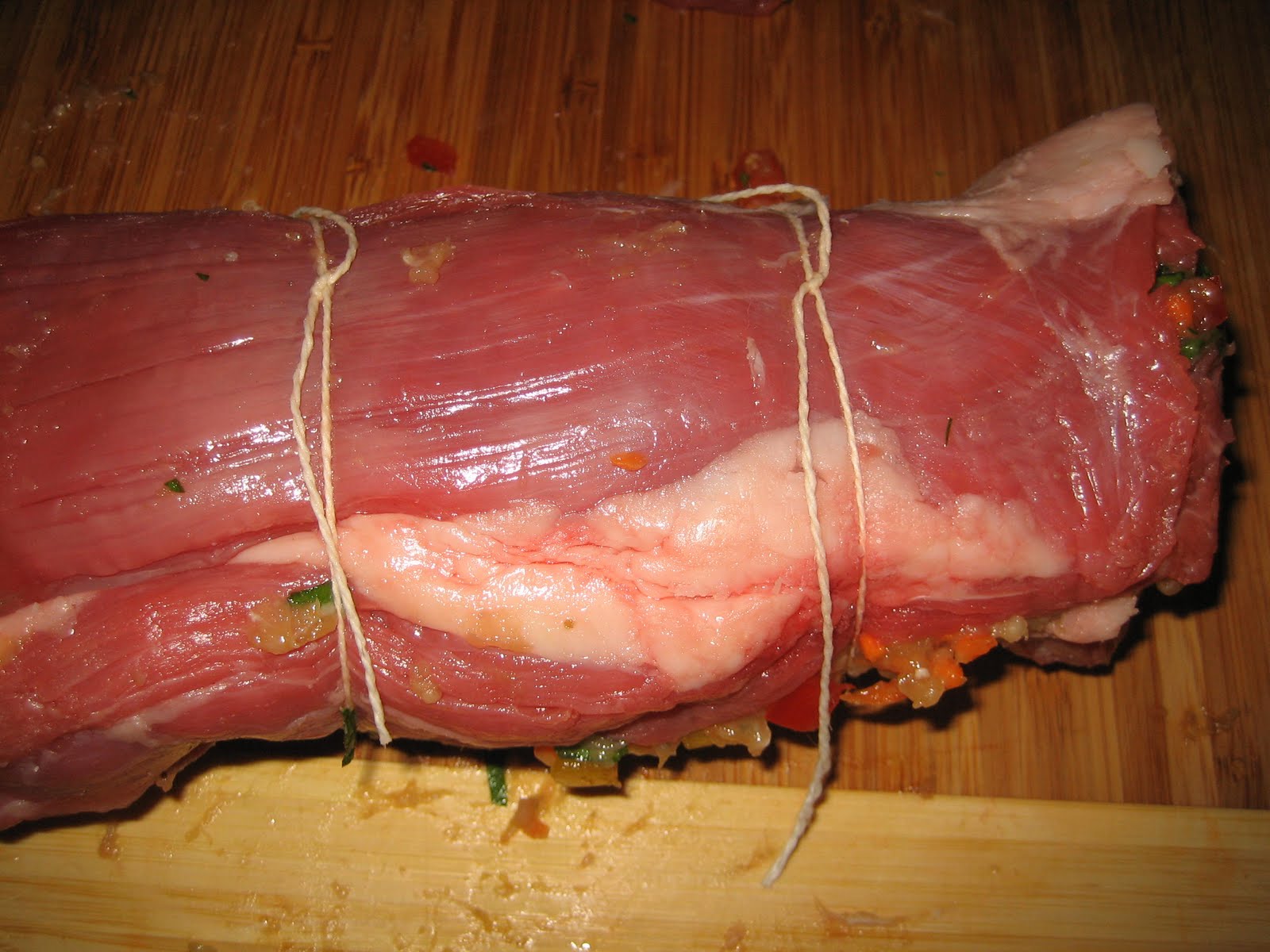
Place ground chicken in a large bowl, stir in peppers, carrot, garlic, and parsley.  Mix 1 tbsp of olive oil, soy sauce, and bouillon.  Spread the chicken mixture over the butterflied beef.  

 Roll the beef around the filling and tie securely with kitchen twine.  Wrap in plastic and refrigerate for 1-2 days (I skipped this step through bad timing, but I'm sure it would have spread the flavors nicely).  Remove from the fridge at least 30 minutes before cooking to allow the roulade to reach room temperature.  


Heat 3 tbsp of olive oil in a skillet over high heat.  Brown the beef on all sides, creating a nice crisp crust, about 2 minutes on each side.  Allow the meat to rest for 10 minutes, then place the meat at the center of a sheet of aluminum foil and wrap it tightly.  Place the foil packet seam side up in a baking dish and bake at 225 degrees.  The recipe says to cook it this way for 2 hours.  I felt it was a little overdone for my taste and would probably cook it for about 1.5 hours next time, being careful to check that the chicken is completely cooked.  


Open the foil, save any juices that have accumulated, and slice the meat into 3/4 inch slices.  Serve with the juices drizzled on top.  


Apart from the meat being overcooked for my taste, the flavor of the beef with its chicken stuffing was surprisingly good.  Everyone seemed to enjoy and a few even requested seconds. 


Torta Capixaba 
(Baked Crab Frittata)


2 tbsp olive oil
1 onion, thinly sliced
1 scallion, thinly sliced at angles
3 cloves garlic, pressed
1 lb lump crab meat (you can also use any combination of shrimp, scallops, or other seafood)
2 plum tomatoes, peeled, seeded, and diced
4 large eggs
2 tbsp fresh parsley, chopped
Salt and pepper to taste 
Sliced green pepper and tomato for garnish


Preheat the oven to 350 degrees. Heat the oil in a large frying pan over medium high heat and saute the onions and scallions until they are soft, about 3 minutes.  Add the garlic and saute for another minute. 


Season the crab meat with salt and pepper and add it, with the tomatoes and parsley to the onion mixture.  Whisk the eggs.  You can bake this in one large pie pan, or you can make individual frittatas using small ramekins.  I poured a bit of the whisked egg into the bottom of each ramekin, filled 3/4 full with crab mixture, then topped with the remaining egg and garnished with tomato and pepper. 


The recipe says to cook it for 20 to 30 minutes until the eggs are set, but I guess I like my eggs a little more well done than that, I baked mine for about 45 minutes.  Serve warm and enjoy.


This was by far the winning recipe of the night.  Due to bad timing and competing oven temperatures, we barely ate any of it.  It was supposed to be a sort of appetizer and I recommend making it first thing before your guests arrive.  As it was, we'd already loaded up on cheese and crackers waiting for the beef to finish and I only popped the frittatas in the oven at about 9:30 (it might have been closer to 10).  However, it's a beautiful dish and a real crowd pleaser. 


About the stories:  


The book is arranged chronologically, so I got the post-Colonial stories first.  The best one that I read was called "The Fortune Teller" by Machado de Assis and it's a clear warning not to tempt the fates by asking your future.  In a torrid love triangle, a man's best friend and his wife both consult the same fortune teller to ensure that their life of lies will continue happy.  She assures them, separately, that they will be happy and she collects a large fee from each.  Let's just say, she only tells them what they want to hear.  This would have been a great story for the summer's critical lens about a man's fate being controlled by what he believes rather than by external forces.  In the end, duped by a false sense of success, the husband kills them both. 


The irony lives in Camillo's struggle to overcome his curiosity of the fortune teller.  He works himself full circle from pure scepticism that Rita would even contemplate doing such a thing, to believing that it is fate that stops his carriage right at the fortune teller's door.  He convinces himself through fear and the desire for reassurance that consulting the old woman will protect him.  His initial reaction to his friend's summons, run away!, is ignored because he feels invulnerable.  He walks blindly into the friend's house and into his own death.

Such is fate.   

7.27.2010

Last Chapter of Iracema - Pastels Fritos and a Hunger Strike

"The Mayri, which Martim founded on the riverbanks within the shores of Ceará flourished. The Word of the true God budded in the savage land, and the holy Church-bells re-echoed through the valley; where once bellowed the Maraca."
 
Book:  Iracema by Jose de Alancar
Recipes:  Created Specifically for Ben Killen


Pastels Fritos
(Fried Shrimp and Cheese Treats)


1 lb cooked shrimp, peeled, deveined and cut into small pieces
1 lb faux Catupiry cheese
1 bunch Fresh parsley, chopped
20 Goya Empenada wraps 
Salt and pepper to taste
Oil for frying


Mix the filling together over low heat to keep the cheese smooth.  Spoon filling into the center of the wraps, fold the wrap in half and seal by crimping the edges with a fork.  


Flip the treat over and crimp with a fork on the other side as well.  Heat the oil over high heat and fry the treats until they are golden brown.  


They are quite good.  And there is a whole tupperware full of them just for Ben.  


About the book:  


My final reaction:  You have got to be kidding me!  The good news is that she did not kill her own brother.  Apparently she just wounded him.  He comes back to see her in her loneliness and just when you think he's about to kill her to fulfill their father's prophecy, you realize that she's actually going to die of a hunger strike.  Martim goes away to make her safe and she, the daughter and sister of warriors, can't stand to be alone with her son and she dies.  She almost kills the son in the process.  "The daughter of Araquém at last began to feel that her veins were drying up, and withal her life, embittered by sorrow, rejected the nourishment which might have restored her strength. Tears and sighs had alike banished the smile and the appetite from her beautiful mouth."  When Martim comes home, triumphantly having kept his own Portuguese people from invading, you would think she'd get better, but no, "Iracema rose no more from the hammock where the afflicted arms of Martim had placed her. The husband, whose love was born anew with paternal joy, surrounded her with caresses, which filled her soul with its former happiness. But they could not bring her back to life. The stamen of her flower was broken forever."  And she expires.  And in his grief, he goes back to Portugal and returns with a conquering army.  


Pro-colonial literature is lame. 

7.25.2010

Chapter 29 - Roast Chicken, King Style, Stuffed with Farofa and I am Almost Done with this Darned Book

"Woe to her! ... The blow had struck home to her heart, and, like the Copaíba, wounded in the core, she shed tears in one continuous stream"

Book:  Iracema by Jose de Alancar
Recipes:  The Brazilian Table by Roberts and Roberts

Roast Chicken, King Style, Stuffed with Farofa


For the dried fruit farofa:


1 1/2 cups dried fruit (apricots, figs, plums), roughly chopped
1 cup hot water
1/2 cup butter
2 tbsp oil
1/4 cup onion, finely chopped
1/4 cup garlic, pressed
3 cups cassava flour
1/2 cup onion confit
1/4 cup scallions (omitted accidentally)
Salt and pepper to taste


Soak the fruit in the hot water for 5 minutes or until soft, then discard the water.  Heat a skillet over medium high heat, melt the butter and oil and saute the onion for 3 minutes.  Add the garlic and saute for another 3 minutes, add 1/2 the fruit and sate rapidly mixing well.  


Pour the cassava flour through your fingers slowly, stirring constantly.  Don't just dump it in as I did, though, I'm not sure it would have made any difference.  Lower the heat and keep moving the flour from side to side for about 5-8 minutes.  Add the remaining fruit, onion confit, and scallions (unless you forgot to buy them).


For the chicken:

1 whole chicken
2 cups chicken stock
2 large onions, cut into eighths
4 tbsp melted butter
Salt and pepper to taste


Preheat the oven to 400 degrees.  Rub the chicken inside and out with salt and pepper.  Stuff the bird with 4 cups of dried fruit farofa.  Truss it up and bake it on the rack of a roasting pan on its back, and fill the pan itself with stock and onions.  Baste with butter every 20 minutes, and bake for 50 minutes.  Lower the heat to 375 and bake an additional 20 minutes without basting with butter.  Use a conventional thermometer to check for doneness (I used to advocate the digital thermometers, but broke up with them after my last overcooked turkey).  


This is roughly how the cookbook says to make this dish.  But since I already had some boneless, skinless thigh meat in the freezer, I defrosted that instead and made it my way.  Basically, the process was pretty much the same, except that I pounded out my chicken to a uniform thickness and wrapped it around the farofa, using some kitchen twine to keep it all in place. 


Kitchen helper Jay was in charge of chopping onions, making chicken stock, and taking pictures.  


I know I said in an earlier post that I would never make farofa again, but this recipe seemed to be moister, closer to actual stuffing as we know it.  Sadly, it still feels as though you are eating flour.  Again, the flavor was great, but Jay and I were adamant that it would have been much, much better if we'd put all that dried fruit into a cornbread stuffing mixture instead.  


About the book:


Nothing has changed since my last post (1 hour ago).  Brazil is still going to be invaded by the Portuguese for 300 years and Iracema is still going to die.  Ain't love grand.

Chapter 29 - Coxinha de Galinha and History is Written By the Victors

"'Poti has arrived at the cabin of the great Maranguab, father of Jatobá, and has brought his white brother to see the greatest Warrior of the Nations.' The old man only opened his heavy eyelids, and passed a long but feeble, look from the grandson to the stranger. Then his chest heaved and his lips murmured— 'Tupan wills that these eyes should see, before being quenched, the White Hawk side by side with the Narceja.'"  (Editor's Note:  "O gavião branco, the white hawk, whilst Narceja is the snipe. Batuireté in thus calling the stranger, and speaking of his grandson as a snipe by comparison, prophesied the destruction of his race by the whites. These are the last word he speaks.")

Book:  Iracema by Jose de Alancar
Recipes:  The Brazilian Kitchen by Leticia Moreinos Shwartz

Coxinha de Galinha
(Chicken Fritters)


For the filling:


1 tsp olive oil
1/4 cup shallot, minced (omitted because while at the store I thought I had one at home...)
2 cloves garlic, pressed
1 pickled sweet red pepper, drained and finely chopped
1 cup cooked chicken, shredded
2 tbsp mayonnaise
3 tbsp chives, chopped


Heat the oil over medium high heat.  Saute the shallots (if you bought them) until they are tender, add the garlic and peppers and heat through.  Mix the pepper mixture with chicken, mayo, and chives.  Chill until you're ready to assemble the fritters.


For the fritters:

1 cup plus 2 tbsp of chicken stock
1/2 tsp olive oil
1 tsp salt
1/8 tsp turmeric (optional, but I included it, gives a nice flavor and rather dramatic yellow color)
1 cup flour, plus extra for kneading
A plate of flour, a plate of lightly beaten egg whites, and a plate of bread crumbs for dredging 
Oil for frying


Heat the soup stock in a casserole pan.  Add the oil, and turmeric (I omitted the salt because I use already salty bouillon cubes).  Add the flour all at once and stir vigorously for one minute to dry the dough.  


For the next step, you could knead it on your own, but I highly suggest a food processor with the bread kneading attachment.  The dough is remarkably sticky, and when the processor is done with it, (about 5 minutes) it will closely resemble the color and texture of play-doh, except with a much more pleasant smell.  Scrape the dough out onto a well (stressing WELL) floured surface and knead by hand into a flat disk (it will still be hot, so I just let mine sit for about 10 minutes before touching it).  When it has reached room temperature, roll the dough until it is about 1/8 inch thick.  Use a 3 inch round cutter (or the widest glass you have, in my case this is only about 2.5 inches) to make your rounds.  


To assemble the fritters:


Fill each round with just under a tablespoon of filling.  Lift up and pinch together 2 sides.  Then gather the other edges to meet in the middle, making a "beggar's purse."  This can then be elongated gently to make the "classic drumstick shape" at which I failed miserably.  The dough, again, is very sticky, I kept some on hand for emergency repairs whenever my filling poked out, which happened quite often.


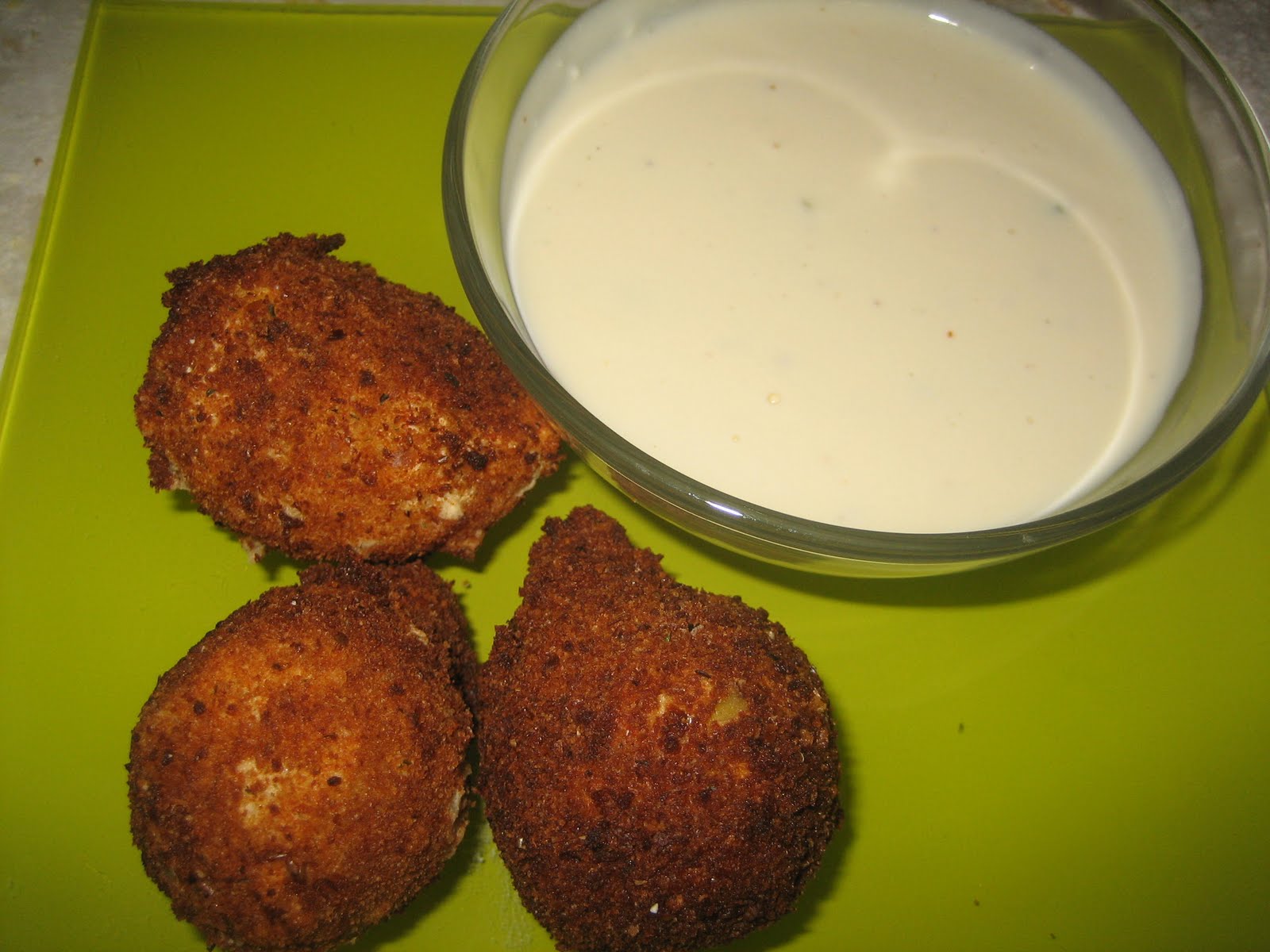
Once the fritters are shaped, coat each one in flour, dip it in egg white, and then coat it in bread crumbs.  Heat the oil over high heat and fry until golden and crispy.  Keep warm until the sauce is ready.  


For the cheese sauce:


1 1/2 cups chicken stock
1 1/2 cups Catupiry cheese (a web site told me that if you can't find this, you can make faux-Catupiry cheese by melting together 2 blocks of cream cheese with close to a pound of Meunster cheese.  It's actually pretty tasty)
2 tbsp chives, chopped
Black pepper to taste


Heat the stock in a sauce pan over medium-low heat.  Add the cheese and whisk until it is completely melted and integrated into the stock.  Add the chives and season with pepper. This is the dipping sauce for the fritters and it's pretty delicious. 


The cookbook says this is classic Brazilian bar food, so I made it to celebrate the triumphant return of our friend Anthony.  He was laid low for a bit by some medical issues, but is feeling back to his old self, for which we are thankful.  The fritters and the cheese sauce got a little cold on the trip to our favorite haunt but this didn't stop them from being devoured by the company.  They even got compliments from a stranger whose seat we'd unwittingly taken and to whom I offered snacks in recompense (sorry Ben, I guess that guy ate the 2 that should have gone to you).  


About the book:

There are some prophesies that are written after they have come true.  In this case, the passage I cited above is used to show undoubtedly that the Portuguese Martim was meant to take over Brazil.  And not just a small part of it, he gets bored with his wife, his friend Poti, his hunting and fishing and hiking around.  We are told that he is filled with "ambition."  And poor Iracema speaks her own prophecy, "When the White Warrior's son has left the bosom of Iracema she will die, like the AbAtil, after it has yielded its fruit. Then he will have nothing to detain him in a foreign land."  But she is mistaken, she is not going to be cast off for a "white virgin" but for the entire land of her very own people.  As with the prophecy of Batuireté, who has stayed alive only to see the conqueror of his land, Iracema's will most likely also come true, as it is equally written by a victor, seen through the lens of hindsight. 

7.23.2010

Chapter 22 - Arroz e Feiao and A Great Battle is In the Making

 "Wine appeases the thirst of the body, but breeds another and a wilder thirst in the savage mind."

Book:  Iracema by Jose de Alancar
Recipes:  The Brazilian Kitchen by Leticia Moreinos Shwartz

Arroz e Feião
 (Rice and Beans)


For the Rice:

2 cups white rice (or brown Basmatti, if that's what you happen to have on hand)
2 tsp salt
4 tsp olive oil
2 cloves garlic, pressed

Rinse the rice in cold water.  Bring 4 cups water to boil in a pot and add the salt, oil, garlic, and rice.  Follow the package directions (for brown rice, it's 50 minutes, for regular white rice, it's usually 25 minutes, for boil-in-a-bag minute rice, it's usually one minute, if you believe in such things).  Keep the rice warm until the beans are ready.


For the beans:

2 large cans of Goya beans (or you can soak a pound overnight, but I'm way too lazy for that) complete with their juices
1 medium onion, chopped
3 bay leaves
1-2 tbsp Worcestershire sauce

1 package of good, salty uncooked chorizo sausage (this was my own addition, for protein and flavor) 

Brown the sausage in a large skillet over medium high heat, remove from heat and slice into 1/2 inch portions (or so).   Add olive oil to the pan juices and saute the onions over medium heat.  Add the beans and their juices, bay leaf, and Worcestershire, salt and pepper to taste.  Return the sausage to the pan and simmer the mixture for at least 20 minutes.  


Serve the beans and sausage over the rice.  Delicious.  We served ours alongside some oversteamed broccoli, but recommend that you time yours a little more carefully.  We also had some Caipirinhas with simple syrup (Thank you Julie!).


And some Pao de Quijo while we were waiting for dinner to be ready.  


Special thanks to kitchen helper Jay who I'm told enjoyed the leftovers.  My own leftovers are slowly disappearing; this is one of those dishes that actually tastes better the longer it sits all together.  


About the book:


There's a big fight brewing over Iracema and her treachery.  They fought a little battle, the Tabajara's lost many men.  It's not 100% clear, but I think the former-maiden killed her own brother, who was on her side until she gave up the goods.  They have run away to the Potiguaras and she actually has the nerve to be sad and ask Martim to take her away from the village of those who murdered her brethren, as though she had nothing to do with it personally. What a brat. 


I'm a little bored by this book, which is why I haven't had a lot to say about it.  Currently, Iracema and Martim are about to found their own village, which I gather is the basis of the Brazilian mythology, their village being the very first "Brazilian" village. What fun for colonization!